

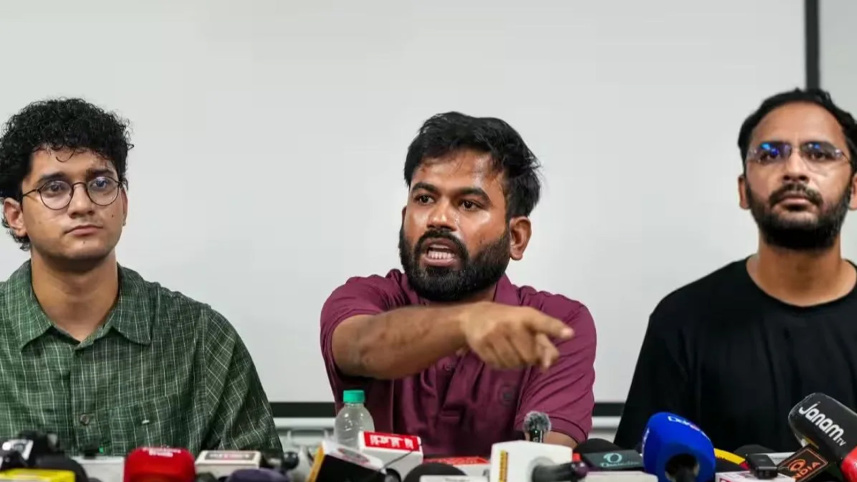
Police arrested more than 2,000 people and closed down central Delhi to thwart yesterday’s protest. Thousands of police and paramilitary forces remain deployed in the Indian capital today.
A court has ordered the release of Abhijeet Dipke, founder of the " cockroach party ," and two other leaders. They were arrested yesterday when their plane landed in Delhi, where the movement planned to gather thousands of people in the center of the Indian capital.
Dhruv Rathee, an influential social media figure, was also among those detained. He was released after midnight on the condition that he not participate in any of the protests.
In Geneva, the High Commissioner for Human Rights called on the government to immediately and unconditionally release all those “arbitrarily detained” in New Delhi, and to guarantee respect for the rights of assembly and demonstration. The Ministry of External Affairs responded that the UN demand is “selective” and constitutes “unjustified interference in India’s internal affairs.”
130 million voters erased from the electoral rolls
The protests demand the resignation of the head of the Electoral Board, Gyanesh Kumar, over a review of the voter lists that benefits Modi’s ruling Bharatiya Janata Party (BJP), which has been in power for more than 12 years.
In late September, the Indian Express newspaper reported that two MPs had expressed concern about the review of the electoral roll, registration procedures, and digital systems.
According to data from the Election Board, some 130 million names, more than the population of Japan, have been removed from the electoral rolls during the verification exercise, including 63 million people who had changed their address and 30 million who could not be traced.
Those who have disappeared from the electoral lists are members of minorities, such as Muslims, who do not support the ruling party.
Despite the repression, the " cockroach party " has vowed to continue the protests. Its emergence is a clear indication that the deep political crisis is not unique to European political systems, but rather has a global reach.
Critical coverage of India in the west died the day Modi became President. The last substantial critical look from the west was that BBC documentary about Modi’s pogroms of Muslim in Gujrat from when he was the Chief Minister there. You’ll get one or two token pieces of news as was the case when Article 270 was abrogated for Kashmir but apart from that the Modi government is tolerated because outside of buying oil from Russia it is completely subordinate to the Americans.
All opposition parties are part of the protest. CPIM being involved is no surprise considering that.