

Chile: Shield of the Americas and National Security Doctrine
By Resumen Latinoamericano on August 14
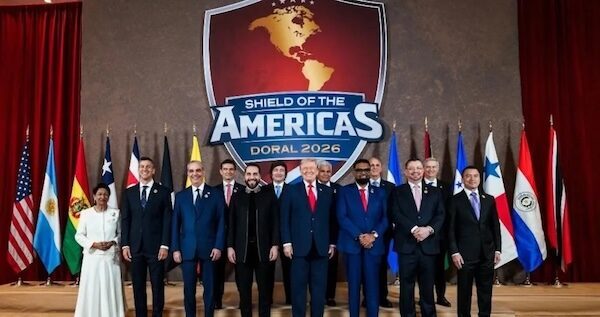
It has recently come to light that the United States government intends to operate a Western Hemisphere Joint Task Force comprised of the 18 member states of the Coalition Against Cartels in the Americas, another name for the Shield of the Americas, created by President Donald Trump last March in Miami. Chile is one of the member countries, along with Argentina, Bolivia, Costa Rica, the Dominican Republic, Ecuador, El Salvador, Honduras, Panama, Paraguay, and now also Peru and Colombia, among others.
This body will be led by U.S. Marine Corps Major General Kevin Jarard and will be the “operational arm of Southcom.” It is expected to strengthen intelligence sharing, expand combined training, improve interoperability and capabilities of participating military forces, while also supporting maritime interception efforts and, when necessary, providing humanitarian assistance and disaster relief.
This joint force, as we wrote, will be led by the same U.S. Army Southern Command responsible for a series of attacks and extrajudicial killings of alleged drug traffickers’ vessels, and also responsible for the kidnapping, last January, of President Nicolás Maduro in Venezuela, situations that are contrary to international law and which, although for now they may go unpunished due to the lack of power and the hollowing out of international organizations, will one day have to answer for them.
The United States is once again insisting that Latin American armed forces become involved in internal security matters, such as combating and dismantling drug trafficking organizations—an area historically designated for law enforcement. In contrast, the U.S. Posse Comitatus Act of 1878 prohibits the military from engaging in law enforcement or drug control within its national territory.
Similarly, the bill in the Chilean Congress that seeks to grant the Armed Forces the authority to conduct identity checks, along with the continued presence of the Armed Forces in the Mapuche territory and in migrant control on the northern border, are negative situations that distance the Armed Forces from their mission and purpose, threaten respect for human rights, and will continue to erode the respect and unity that the population should have with its Armed Forces, whose reputation, as we know, is already severely damaged by their actions during the civic-military dictatorship and during the 2019 social uprising, where military personnel also committed serious human rights violations.
Likewise, the government’s intentions, expressed by the Minister of Public Security, Martín Arrau, to “combat, together with the Armed Forces, serious disturbances to public security with a special focus on areas dominated by drug trafficking networks and organized crime” - as reported by Cooperativa - is a major danger that could have very serious consequences.
The Armed Forces must not be used by the political class in matters and operations of internal security and must never again repress the social protests of the very people they swear to defend.
The “enemy within”
As we know, it was at the U.S. Army’s School of the Americas that Chilean and Latin American militaries were indoctrinated with the National Security Doctrine, which created the specter of the “internal enemy,” attributed then to “communists and revolutionaries,” and now, in these changing times, to criminal and terrorist organizations. The U.S. always seeks pretexts for the Armed Forces to become involved in matters of internal security, which has often led to repression and a bloodbath of the civilian population. This benefits the northern superpower, transforming the Armed Forces into policemen of their own nation, distracting them from the real issue where they should be focusing their efforts: the defense of our territorial sovereignty, currently in dispute in a turbulent and unstable environment. Continuing to bet on and support a declining and criminal power like the U.S. will have consequences in the present and the future.
In this regard, the Chilean state as a whole should reflect on all the components that make up our sovereignty and that must be strategically protected and safeguarded for our country, and no longer for the benefit of foreign powers. We continue to wait to see a political class that is not so treacherous and that cares for Chile and all its inhabitants.
It is worth recalling the clear words of Argentina’s former defense minister, Nilda Garré, who in 2006 withdrew Argentine troops from training in the US. She stated that “The School of the Americas has done a great deal of harm and continues to try to promote the ‘fight against drug trafficking and the fight against terrorism’ narratives within the Armed Forces. Our internal legislation stipulates that drug trafficking and terrorism are issues that must be addressed by the security forces, not the Armed Forces, so as not to return to the situation where the Armed Forces become involved in domestic politics and begin to pursue, in quotes, ‘terrorists and drug traffickers’ deployed within the country and interfering with the civilian population.”
The issue of drug trafficking and the rise of criminal organizations—Trojan horses used to destabilize our nations—is a complex one. The United States, among others, is one of the world’s largest consumers of drugs, a situation exacerbated by the ineffectiveness (or complicity) of its police forces and the DEA, which have failed to dismantle these criminal organizations. It is curious, to say the least, that despite having various intelligence agencies, police forces, technology, and numerous other resources, the United States has been unable to put an end to drug sales. As long as the demand for drugs in the US and Europe persists, we are all far from resolving this problem.
In Chile, this problem cannot be solved with more states of emergency, more repression, or more prisons. It requires intelligence and public policies that strengthen prevention and rehabilitation for young drug addicts. Sadly, there is neither the intelligence, nor the public funds, nor the interest to rehabilitate so many young people and provide them with free education and genuine opportunities to improve their lives. As always, a social problem is being addressed through force and repression, the offspring of the National Security Doctrine.
Puro lameculos de Trump. Los hubieran puesto empinados.
Well I agree. However, Chile is in the BRI and those Chinese investments won’t simply disappear.